Newport Bayfront fire: evening update and heartfelt thanks (Oct. 25)
Update – One week after the Bayfront fire: A week ago, a fire destroyed Pacific Seafood’s freezer building on the Newport Bayfront. Everyone at the plant was accounted for, no civilian injuries were reported, and firefighters kept the fire from spreading to the main processing plant. Evacuations were lifted that night, most of the Bayfront reopened the next day, and Pacific Seafood reported its employees back at work and its other Newport facilities processing as usual. The Oregon State Fire Marshal, with Newport Fire, is investigating the cause.
Thank you to Newport’s firefighters and the crews who came from across Lincoln County and beyond, along with the state hazmat team, the Coast Guard, our police and sheriff’s deputies, and the school staff and church that looked after evacuees. The loss is real for Pacific Seafood’s workers and our fishing families, and recovery will take time. We’ll be here for it.
Evening update: Sunday, October 25, 2026. I’m Commissioner Casey Miller. This is my community update, not an Emergency Operations Center message. The latest published status below is from the Sheriff’s 6:27 p.m. final update for tonight.
Latest official information
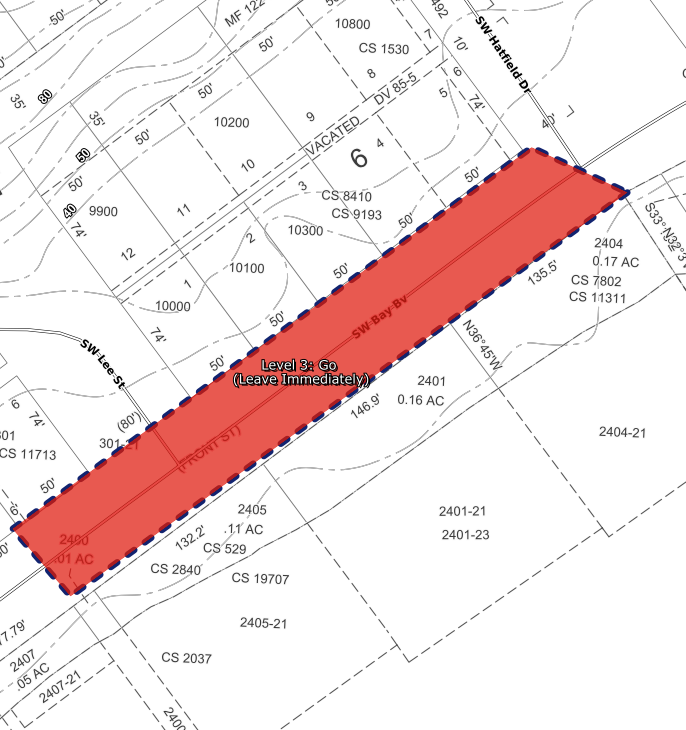
The Sheriff’s Office reports that evacuation levels have been lifted except along Bay Boulevard between Hatfield Drive and Port Dock One, next to Clearwater Restaurant. Businesses in that area remain evacuated. The evacuation point at Atonement Lutheran Church is now closed. Read the Sheriff’s final update for tonight.
I spoke with the sheriff this evening, who confirmed that the Emergency Operations Center has closed. Please continue to respect the remaining closure and follow official instructions.
Thank you to everyone who stepped up
Tonight, my thoughts are with the Pacific Seafood workers and their families, our fishing community, nearby businesses. Everyone affected by today’s Bayfront fire.
Thank you to Newport’s firefighters and the supporting crews who helped neighbors through a frightening day. Thank you to the City of Newport, county staff, and partner agencies working together throughout the response.
I spoke with the sheriff this evening, who confirmed that the Emergency Operations Center has closed.
The Sheriff’s final update tonight lifted evacuation levels except along Bay Boulevard between Hatfield Drive and Port Dock One, next to Clearwater Restaurant. Businesses in that section remain evacuated. The evacuation point at Atonement Lutheran Church is now closed. Please respect the remaining closure and continue following official alerts.
I’ve updated my blog with the day’s timeline, official information links, and an explanation of how local responders, county emergency coordination, and mutual-aid partners work together:
The full impact is still unfolding, and people will need support beyond today. Thank you to everyone who stepped up
How mutual aid and an expanding response work
Oregon’s emergency response system starts locally. Cities, fire districts, and other responsible local agencies manage incidents within their authority, drawing on their own personnel and established partnerships. When more help is needed, they can request additional crews, equipment, or specialized support. The Oregon Department of Emergency Management describes local response as the starting point, with state coordination available for larger incidents or those involving multiple jurisdictions.
Mutual aid is an established part of that system. The Oregon State Fire Marshal explains that fire agencies can request neighboring departments through Oregon’s fire mutual-aid system, with broader support available as needs grow. These partnerships let communities share resources rather than expecting every department to maintain every capability on its own.
Here in Lincoln County, the county’s June 11, 2026 Emergency Operations Plan, sections 5.2–5.3 (pp. 111–112), says the responding agency establishes on-scene incident command. The county Emergency Operations Center can support that command with resources, communications, and public information. The plan allows outside assistance when an incident threatens to exceed county response capabilities. That means requests can anticipate growing needs; responders do not have to wait until every resource is exhausted.
As an incident becomes more complex, coordination can expand too. Under Unified Command (2026 EOP, section 5.5.4, p. 121), agencies with jurisdictional authority or functional responsibility work toward shared objectives while retaining their own authority and accountability. Additional help does not automatically transfer command to the county or state. These are established arrangements for communities to support one another. This explains the general framework; the notices linked above provide the confirmed details of today’s response.

Supplement: elected officials and emergency response
Elected officials have an essential leadership role during an emergency: providing policy direction, securing resources, and keeping the public informed. FEMA’s training for senior officials distinguishes those responsibilities from setting incident objectives and directing tactical operations, which are delegated to qualified incident commanders and responders.
That distinction concerns responsibilities, rather than a blanket rule about physical location. FEMA’s Local Elected and Appointed Officials Guide includes participation in EOC policy or multiagency coordination group meetings at the EOC or another designated site. Officials must remain engaged and available for decisions; their particular assignments and the incident’s needs guide how they participate.
Lincoln County’s 2026 plan assigns commissioners to the Policy Group and says the EOC director notifies them whether they need to assemble for strategic policy direction (sections 3.2.1 and 5.4.1, pp. 63–64 and 112). The Board also retains responsibilities for policy, budget, emergency funding, and leadership briefings.
This supplement explains the established division of responsibilities. Physical presence at the fire scene or EOC, by itself, does not establish whether an official fulfilled their assigned role. County leadership remains responsible for supporting the response and making the decisions required of it.
County plan source: Lincoln County Emergency Operations Plan, issue date June 11, 2026, with a signed June 24, 2026 Letter of Promulgation; the cover identifies approval under County Order #07-26-209. Page references above are to that 171-page edition, reviewed for this supplement. The county’s Emergency Management program page provides public plan information; its linked copy may differ from this edition.
Where to get continuing information
For current evacuation and access instructions, use Lincoln Alerts and the county’s live map. Follow the City of Newport, Newport Police Department, Lincoln County Sheriff’s Office, and Lincoln County Emergency Management. Sheriff’s news releases are also available on FlashAlert.
Continue to follow official guidance about smoke, air quality, and any restrictions for your area. Check TripCheck for highway conditions. Call 911 for life-threatening emergencies.
For additional local reporting on the response and its effects on workers and residents, read the Lincoln Chronicle’s Bayfront fire coverage, which also describes school district staff providing food and water at the initial evacuation site.
Earlier updates — retained for context
The timeline below records earlier announcements from October 25. Evacuation areas and shelter arrangements changed during the day; these earlier instructions are superseded by the evening update above.
How today has unfolded
- 9:42 am: Sheriff’s first alert. Fire on SW Bay Blvd. Avoid the area.
- 10:34 am: The City of Newport asks everyone in Newport to stay inside and wear a mask if you must go out. The City cites a possible ammonia hazard. The City identifies the fire as the Pacific Seafood plant.
- 10:58 am: Sheriff’s UPDATE 2. Level 3 “Go Now” within one mile of 213 SW Bay Blvd.
- 1:57 pm: Sheriff’s UPDATE 03. New Level 3 zones were added and some original zones were reduced to Level 2. The evacuation point moved to Atonement Lutheran Church, 2315 N Coast Hwy. Pets are welcome. Samaritan Pacific Communities Hospital is open and operating as usual.
- 2:17 pm: Sheriff’s alert: evacuation level downgraded to Level 2 “Be Set” for the alerted area.
- 4:08 pm — Sheriff’s Update 04: Evacuation levels were lifted in most zones. Level 3 “Go Now” remained in the area bounded by SW Bay Boulevard between Fall Street and Hatfield Drive, Hatfield Drive to SW 10th Street, SW 10th Street to SW Canyon Way, SW Canyon Way to Fall Street, and Fall Street back to Bay Boulevard. Atonement Lutheran Church remained open as the evacuation point for people in that zone, with pets welcome. Read Update 04.
- 6:27 pm — Sheriff’s Update 05, final notice for the night: Evacuation levels were lifted except for the Bay Boulevard closure between Hatfield Drive and Port Dock One, next to Clearwater Restaurant. Businesses in that section remained evacuated. The evacuation point at Atonement Lutheran Church closed. Read the final notice.