Skip to content

Disaster Preparedness

Newport Bayfront fire: evening update and heartfelt thanks (Oct. 25)

Update – One week after the Bayfront fire: A week ago, a fire destroyed Pacific Seafood’s freezer building on the Newport Bayfront. Everyone at the plant was accounted for, no civilian injuries were reported, and firefighters kept the fire from spreading to the main processing plant. Evacuations were lifted that night, most of the Bayfront reopened the next day, and Pacific Seafood reported its employees back at work and its other Newport facilities processing as usual. The Oregon State Fire Marshal, with Newport Fire, is investigating the cause.

Thank you to Newport’s firefighters and the crews who came from across Lincoln County and beyond, along with the state hazmat team, the Coast Guard, our police and sheriff’s deputies, and the school staff and church that looked after evacuees. The loss is real for Pacific Seafood’s workers and our fishing families, and recovery will take time. We’ll be here for it.

Evening update: Sunday, October 25, 2026. I’m Commissioner Casey Miller. This is my community update, not an Emergency Operations Center message. The latest published status below is from the Sheriff’s 6:27 p.m. final update for tonight.

Latest official information

The Sheriff’s Office reports that evacuation levels have been lifted except along Bay Boulevard between Hatfield Drive and Port Dock One, next to Clearwater Restaurant. Businesses in that area remain evacuated. The evacuation point at Atonement Lutheran Church is now closed. Read the Sheriff’s final update for tonight.

I spoke with the sheriff this evening, who confirmed that the Emergency Operations Center has closed. Please continue to respect the remaining closure and follow official instructions.
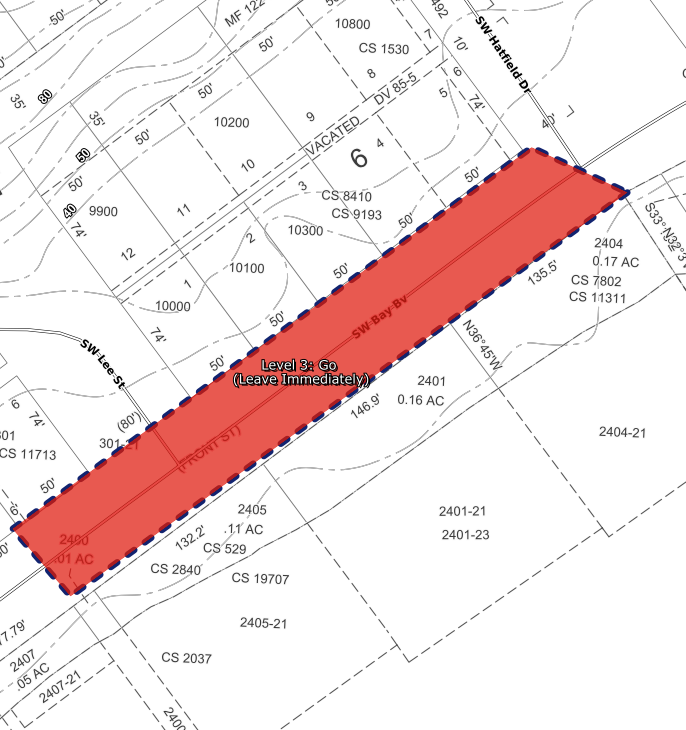
Sheriff’s Update 05 closure map showing the remaining red evacuation area along SW Bay Boulevard near SW Hatfield Drive.
Remaining Bay Boulevard closure shown in the Sheriff’s Update 05, October 25. Source: Lincoln County Sheriff’s Office. This is a snapshot; check the county’s live map and official alerts for current conditions.

Thank you to everyone who stepped up

Tonight, my thoughts are with the Pacific Seafood workers and their families, our fishing community, nearby businesses. Everyone affected by today’s Bayfront fire.

Thank you to Newport’s firefighters and the supporting crews who helped neighbors through a frightening day. Thank you to the City of Newport, county staff, and partner agencies working together throughout the response.

I spoke with the sheriff this evening, who confirmed that the Emergency Operations Center has closed.

The Sheriff’s final update tonight lifted evacuation levels except along Bay Boulevard between Hatfield Drive and Port Dock One, next to Clearwater Restaurant. Businesses in that section remain evacuated. The evacuation point at Atonement Lutheran Church is now closed. Please respect the remaining closure and continue following official alerts.

I’ve updated my blog with the day’s timeline, official information links, and an explanation of how local responders, county emergency coordination, and mutual-aid partners work together:

The full impact is still unfolding, and people will need support beyond today. Thank you to everyone who stepped up

How mutual aid and an expanding response work

Oregon’s emergency response system starts locally. Cities, fire districts, and other responsible local agencies manage incidents within their authority, drawing on their own personnel and established partnerships. When more help is needed, they can request additional crews, equipment, or specialized support. The Oregon Department of Emergency Management describes local response as the starting point, with state coordination available for larger incidents or those involving multiple jurisdictions.

Mutual aid is an established part of that system. The Oregon State Fire Marshal explains that fire agencies can request neighboring departments through Oregon’s fire mutual-aid system, with broader support available as needs grow. These partnerships let communities share resources rather than expecting every department to maintain every capability on its own.

Here in Lincoln County, the county’s June 11, 2026 Emergency Operations Plan, sections 5.2–5.3 (pp. 111–112), says the responding agency establishes on-scene incident command. The county Emergency Operations Center can support that command with resources, communications, and public information. The plan allows outside assistance when an incident threatens to exceed county response capabilities. That means requests can anticipate growing needs; responders do not have to wait until every resource is exhausted.

As an incident becomes more complex, coordination can expand too. Under Unified Command (2026 EOP, section 5.5.4, p. 121), agencies with jurisdictional authority or functional responsibility work toward shared objectives while retaining their own authority and accountability. Additional help does not automatically transfer command to the county or state. These are established arrangements for communities to support one another. This explains the general framework; the notices linked above provide the confirmed details of today’s response.

Supplement: elected officials and emergency response

Elected officials have an essential leadership role during an emergency: providing policy direction, securing resources, and keeping the public informed. FEMA’s training for senior officials distinguishes those responsibilities from setting incident objectives and directing tactical operations, which are delegated to qualified incident commanders and responders.

That distinction concerns responsibilities, rather than a blanket rule about physical location. FEMA’s Local Elected and Appointed Officials Guide includes participation in EOC policy or multiagency coordination group meetings at the EOC or another designated site. Officials must remain engaged and available for decisions; their particular assignments and the incident’s needs guide how they participate.

Lincoln County’s 2026 plan assigns commissioners to the Policy Group and says the EOC director notifies them whether they need to assemble for strategic policy direction (sections 3.2.1 and 5.4.1, pp. 63–64 and 112). The Board also retains responsibilities for policy, budget, emergency funding, and leadership briefings.

This supplement explains the established division of responsibilities. Physical presence at the fire scene or EOC, by itself, does not establish whether an official fulfilled their assigned role. County leadership remains responsible for supporting the response and making the decisions required of it.

County plan source: Lincoln County Emergency Operations Plan, issue date June 11, 2026, with a signed June 24, 2026 Letter of Promulgation; the cover identifies approval under County Order #07-26-209. Page references above are to that 171-page edition, reviewed for this supplement. The county’s Emergency Management program page provides public plan information; its linked copy may differ from this edition.

Where to get continuing information

For current evacuation and access instructions, use Lincoln Alerts and the county’s live map. Follow the City of Newport, Newport Police Department, Lincoln County Sheriff’s Office, and Lincoln County Emergency Management. Sheriff’s news releases are also available on FlashAlert.

Continue to follow official guidance about smoke, air quality, and any restrictions for your area. Check TripCheck for highway conditions. Call 911 for life-threatening emergencies.

For additional local reporting on the response and its effects on workers and residents, read the Lincoln Chronicle’s Bayfront fire coverage, which also describes school district staff providing food and water at the initial evacuation site.

Earlier updates — retained for context

The timeline below records earlier announcements from October 25. Evacuation areas and shelter arrangements changed during the day; these earlier instructions are superseded by the evening update above.

How today has unfolded

  • 9:42 am: Sheriff’s first alert. Fire on SW Bay Blvd. Avoid the area.
  • 10:34 am: The City of Newport asks everyone in Newport to stay inside and wear a mask if you must go out. The City cites a possible ammonia hazard. The City identifies the fire as the Pacific Seafood plant.
  • 10:58 am: Sheriff’s UPDATE 2. Level 3 “Go Now” within one mile of 213 SW Bay Blvd.
  • 1:57 pm: Sheriff’s UPDATE 03. New Level 3 zones were added and some original zones were reduced to Level 2. The evacuation point moved to Atonement Lutheran Church, 2315 N Coast Hwy. Pets are welcome. Samaritan Pacific Communities Hospital is open and operating as usual.
  • 2:17 pm: Sheriff’s alert: evacuation level downgraded to Level 2 “Be Set” for the alerted area.
  • 4:08 pm — Sheriff’s Update 04: Evacuation levels were lifted in most zones. Level 3 “Go Now” remained in the area bounded by SW Bay Boulevard between Fall Street and Hatfield Drive, Hatfield Drive to SW 10th Street, SW 10th Street to SW Canyon Way, SW Canyon Way to Fall Street, and Fall Street back to Bay Boulevard. Atonement Lutheran Church remained open as the evacuation point for people in that zone, with pets welcome. Read Update 04.
  • 6:27 pm — Sheriff’s Update 05, final notice for the night: Evacuation levels were lifted except for the Bay Boulevard closure between Hatfield Drive and Port Dock One, next to Clearwater Restaurant. Businesses in that section remained evacuated. The evacuation point at Atonement Lutheran Church closed. Read the final notice.


Great Oregon ShakeOut: Let’s Be More Ready Than Less

October 15, 2026 — Today’s Great Oregon ShakeOut is a chance to turn concern about earthquakes into something useful: practice. The coordinated drill is at 10:15 a.m. local time. If you miss that moment, choose another time to rehearse with your household or coworkers. Oregon’s official ShakeOut information explains how to participate.

Let’s be more ready than less. Practice helps make us safer. It helps us respond instead of react.

Practice Drop, Cover, and Hold On

Three earthquake safety actions: drop to hands and knees, cover under a sturdy table, and hold on to it.
Earthquake safety graphic: Earthquake Country Alliance. Read the official instructions and adaptations.
  1. Drop onto your hands and knees where you are.
  2. Cover your head and neck. Get beneath a nearby sturdy desk or table if possible; otherwise protect yourself away from windows.
  3. Hold On to your shelter and be ready to move with it until shaking stops.

Adapt the drill to your abilities. If you use a wheelchair, lock the wheels if possible, cover your head and neck, and hold on. Do not attempt to get onto the floor if you cannot safely do so. Accessible safety guidance offers more options. Practice the actions you would use where you live, work or study.

We live in earthquake country

Off our coast, the Cascadia Subduction Zone can produce a magnitude 9 or greater earthquake and a destructive tsunami. Inland communities also face earthquake hazards. Preparedness is part of living here. Oregon Emergency Management’s earthquake guidance explains the risk and protective actions.

Near the ocean, protect yourself during shaking. After a large earthquake, once shaking stops, walk inland and to high ground without waiting for an official warning. Know your local evacuation route before you need it. The first action during shaking and the next action afterward are both worth practicing

During my years as Lincoln County’s public information officer, I saw how Japan’s March 2011 earthquake and tsunami and the dock that later washed ashore at Agate Beach made preparedness feel immediate. In my experience, those events prompted more conversations about our own risks, evacuation routes and whether our families were ready.

The dock came from Misawa, Japan. Torn loose in the 2011 disaster, it drifted across the Pacific before reaching the Newport area in June 2012. Its arrival was separate from the tsunami waves themselves. A preserved section became an educational exhibit and memorial at Hatfield Marine Science Center. OSU’s account tells that story.

There is a personal connection for me, too. Commissioner Terry Thompson was one of the commissioners I worked for. In 2013, he traveled to Misawa with OSU scientist John Chapman and Natural History Museum researcher Leslie Harris as they investigated organisms on replacement docks. The museum’s May 2013 research newsletter, page 7, documents their visit.

What stays with me here is the connection between public service, science and people helping coastal communities understand a shared risk.

Kathryn Schulz’s widely discussed 2015 New Yorker article, “The Really Big One,” brought further attention to Cascadia. Awareness can start the conversation. Practice gives us an action to take.

Well done Lincoln County

After the drill, talk about what you noticed. Is your cover spot accessible? Could something heavy fall nearby? Does everyone know where to meet and how to reconnect? Coastal households should review their evacuation routes together.

Use the Seven Steps to Earthquake Safety to build on the drill, from securing your space and planning communications to supplies and recovery. Oregon’s Be 2 Weeks Ready program provides household planning resources.

We don’t have to solve every preparedness problem in one day. We can practice, find a gap and do something about it.

Let’s be more ready than less.

Waters Systems Alliance Update

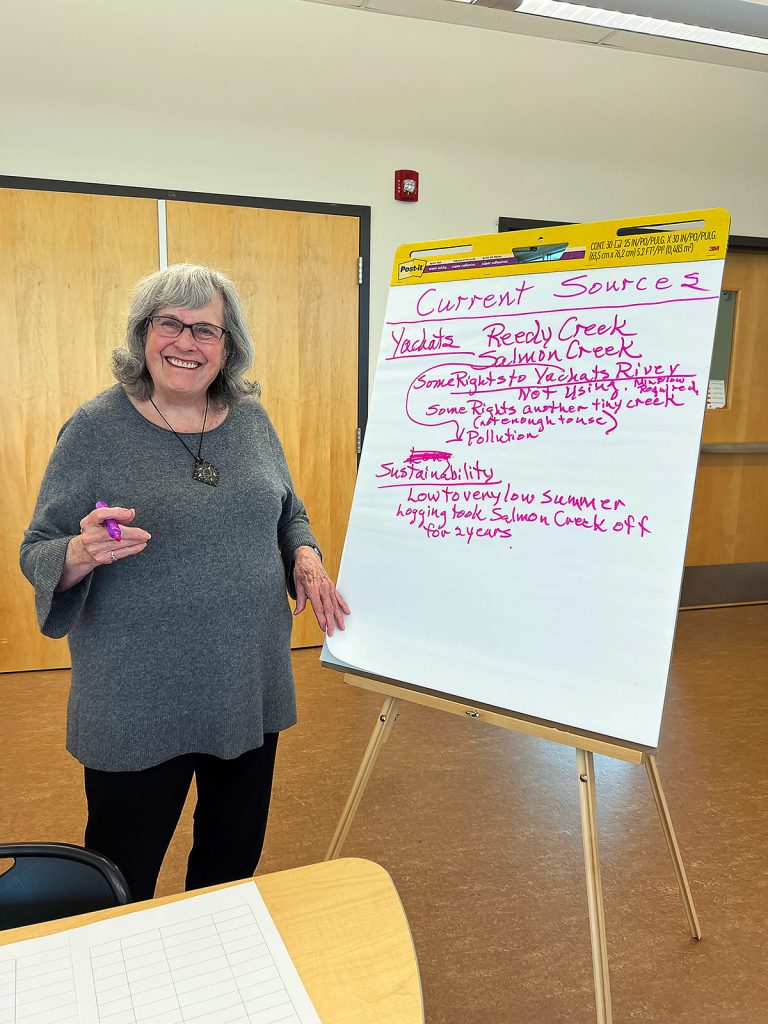
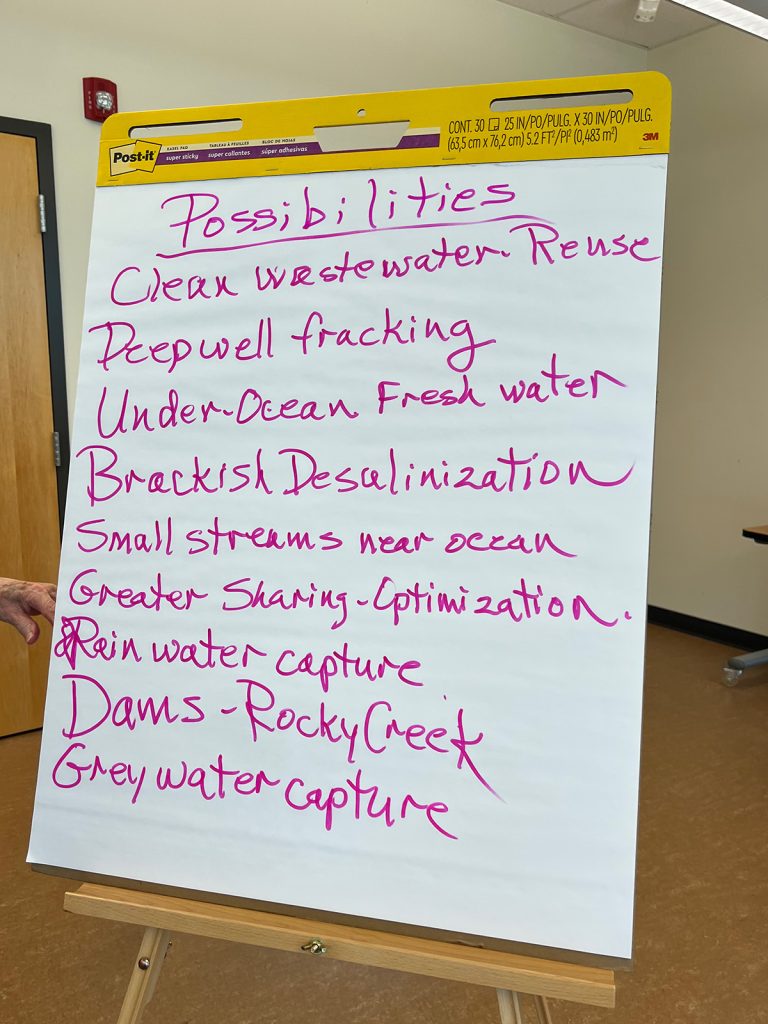
One of the quieter — but potentially most important — long-term conversations happening in Lincoln County right now involves water. Lincoln County is a member of the Water Systems Alliance.

On 10.4.24 Billie Jo Smith came to the Board of Commissioners. On 12.4.24 the entire Board of Commissioners approved the resolution to support the Waters Systems Alliance. We were one of the last jurisdictions across the county to acknowledge and provide our intention to support mission by approving the resolution.

Over the past several years, local governments, water districts, public agencies, and community partners have been discussing the development of the Lincoln County Water Systems Alliance (LCWSA), a collaborative effort focused on strengthening regional water resilience, infrastructure coordination, and long-term planning.

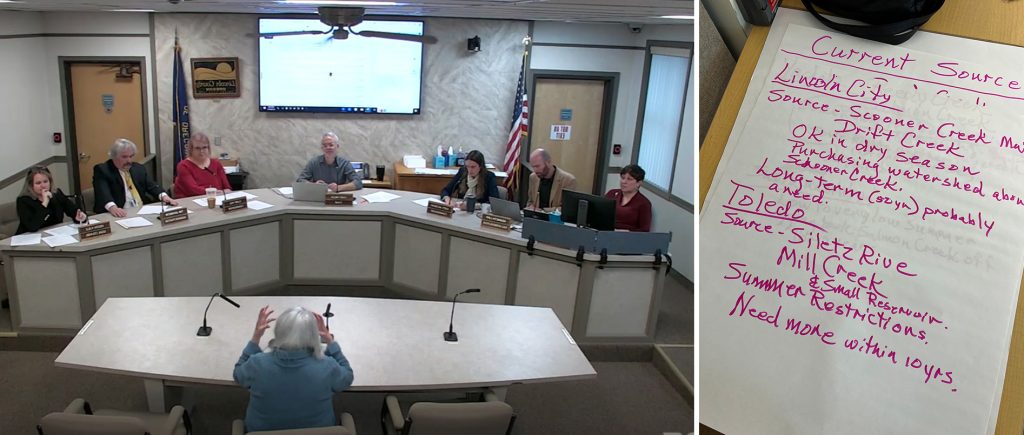
Last week I attended another LCWSA meeting to continue learning more about where the effort currently stands and how Lincoln County can constructively support the work moving forward.

At first glance, regional water coordination may not sound exciting compared to other public issues. But in reality, water infrastructure is one of the foundational systems that determines whether communities can safely grow, respond to emergencies, support housing, maintain public health, and remain economically stable over the long term.

Across Oregon — and especially in coastal and rural communities — aging infrastructure, seismic concerns, climate pressures, drought variability, and emergency preparedness challenges are forcing communities to think more regionally about water systems than ever before.

Lincoln County is no exception.

Many of our local water districts already face major infrastructure responsibilities independently. Existing systems require maintenance, upgrades, redundancy planning, emergency coordination, and long-term investment. Some areas face challenges associated with aging pipelines, landslide zones, storm impacts, or limited system flexibility.

The concept behind the Lincoln County Water Systems Alliance is simple but important:

Rather than every jurisdiction operating entirely independently, communities can work together to:

  • share information
  • coordinate planning
  • identify vulnerabilities
  • pursue grants collaboratively
  • improve emergency preparedness
  • strengthen long-term water reliability countywide

In many ways, this is about moving from reactive problem solving toward proactive regional planning.

The Alliance appears to still be in an early organizational and developmental phase. Current discussions include identifying sustainable organizational support, improving coordination among participating entities, and determining what level of assistance may be appropriate from partner agencies and local governments.

One current request involves approximately $2,000 in county support funding to assist the organization’s ongoing efforts and coordination work.

From my perspective as a County Commissioner, the larger conversation is not simply about one small funding request. The bigger issue is whether Lincoln County is willing to think long-term about water resilience and regional cooperation before larger infrastructure or emergency problems emerge in the future.

If communities can successfully work together across jurisdictional boundaries, the long-term benefits could be substantial:

  • stronger emergency preparedness
  • improved grant competitiveness
  • better infrastructure coordination
  • shared technical knowledge
  • greater system resilience
  • more strategic long-range planning

Water systems are easy to overlook when they are functioning normally. But when systems fail, the consequences quickly become visible for households, businesses, schools, emergency services, and public health systems.

That is why efforts like the LCWSA matter.

The work may not always generate headlines, but thoughtful regional planning today can help protect Lincoln County communities for decades to come.

I remain very supportive of collaborative efforts that encourage jurisdictions to work together constructively, share information openly, and think proactively about the long-term future of essential public infrastructure.

Read Five of County’s Jurisdictional Resolutions

Building a COAD

Over the past several months I have attended multiple Lincoln County COAD (Community Organizations Active in Disaster) meetings. These conversations have reminded me of my former role serving as Public Information Officer for both the Lincoln County Board of Commissioners Office and the Emergency Operations Center during major emergencies and disaster response efforts.

What is a COAD?

What I continue to see is an inspired effort to bring together local organizations, volunteers, nonprofits, faith-based partners, emergency management professionals, and community leaders to strengthen Lincoln County’s disaster preparedness and long-term resilience.

The former Long-Term Recovery Group (LTRG), originally created following the 2020 Echo Mountain Wildfire, is now transitioning into a broader countywide COAD model focused on helping Lincoln County prepare before disasters occur — not simply responding afterward.

I have been encouraged by the many individuals participating in this effort, including former Commissioner Kaety Jacobson, who is helping coordinate many aspects of the transition, along with representatives from Oregon State University Extension, Lincoln County Public Health, wildfire preparedness specialists, emergency response partners, and numerous community organizations.

Explore these links! Local Expertise at Work.

• Aaron Groth — Regional Fire Specialist with Oregon State University Extension
https://extension.oregonstate.edu/people/aaron-groth

• Dan Norton — Lincoln County Public Health
https://www.youtube.com/watch?v=g88ssbxOAB4

• Dustin Rymph — Oregon State Fire Marshal Office (OSFM), former Southwest Oregon Forest Protective Association program manager, and contributor to community wildfire and air quality resilience efforts
https://www.oakridgeair.org

Current efforts include planning around community sheltering, animal evacuation and sheltering, donations management, emergency communications, volunteer coordination, and long-term community resilience.

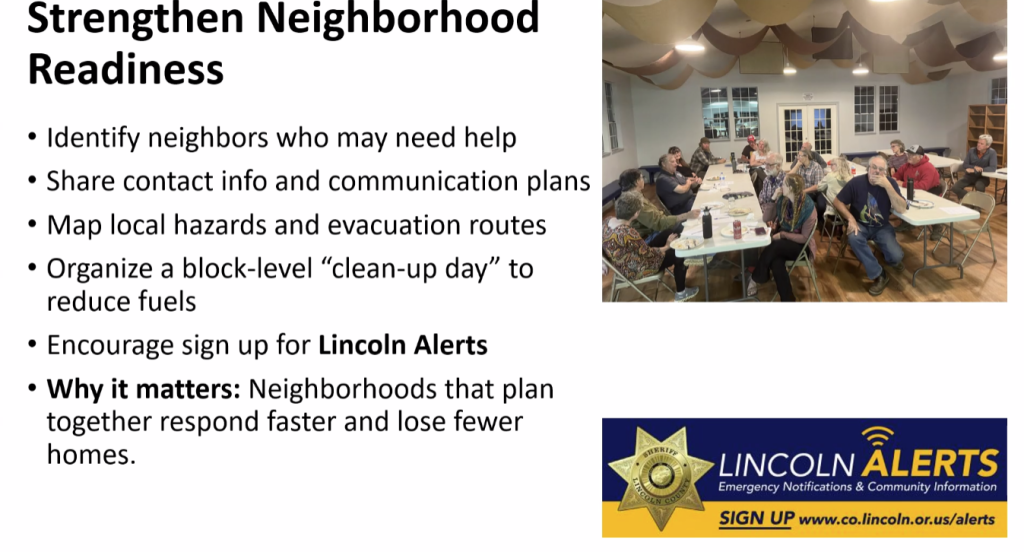
Sign up for Lincoln Alerts

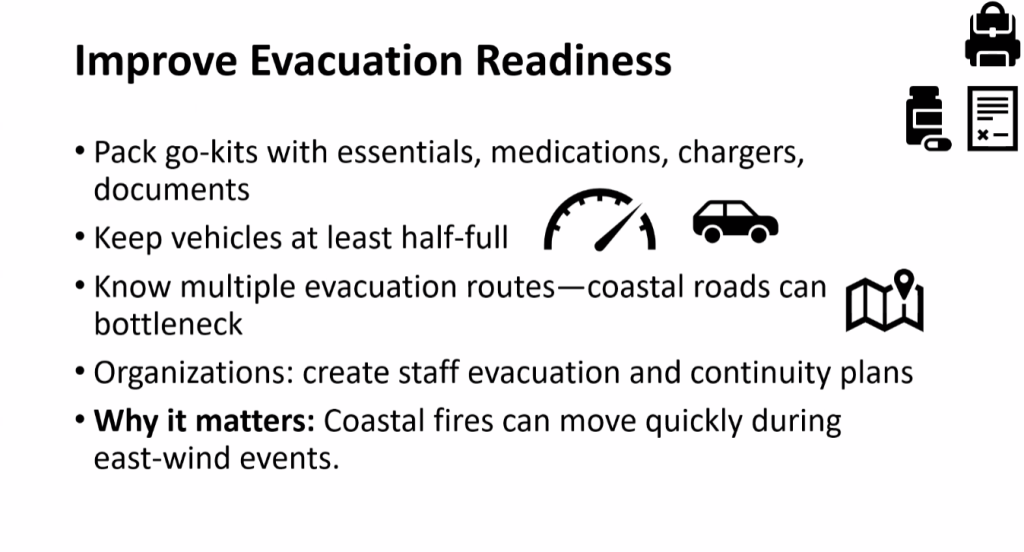
As we enter wildfire season and continue facing risks from storms, flooding, earthquakes, power outages, and other emergencies, preparedness at every level matters.

Community preparedness starts at home. Residents should consider building emergency supply kits, developing family communication plans, preparing for evacuation scenarios, staying informed about local hazards, and checking on neighbors and vulnerable populations during emergencies.


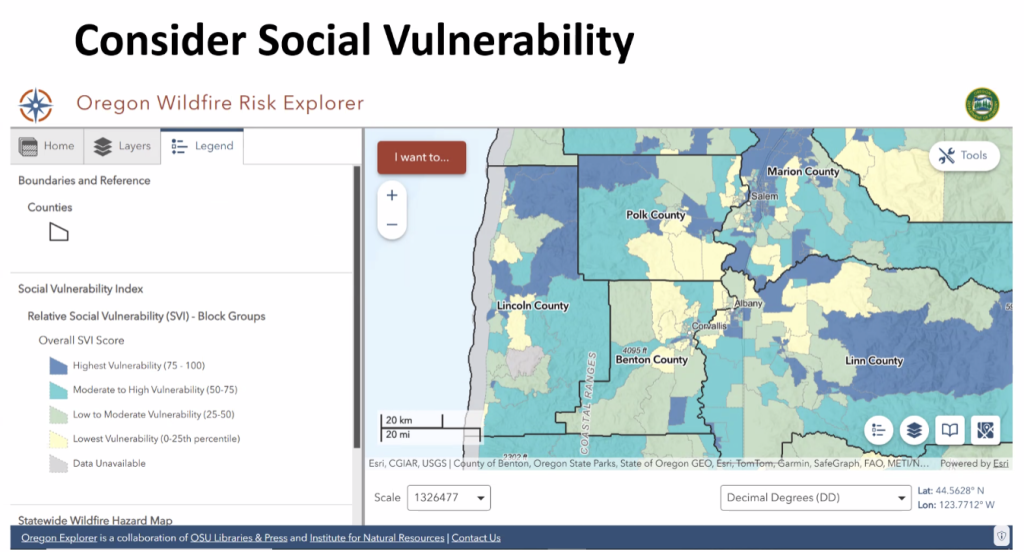
Oregon Wildfire Risk Explorer

The Lincoln County COAD is actively seeking participation from volunteers, nonprofits, businesses, faith-based organizations, emergency response partners, and residents interested in preparedness and resilience. Strong local partnerships built before disasters occur can make a major difference when emergencies happen.

Preparedness is not just a government responsibility. It is a community responsibility — and building resilience starts long before disaster strikes.

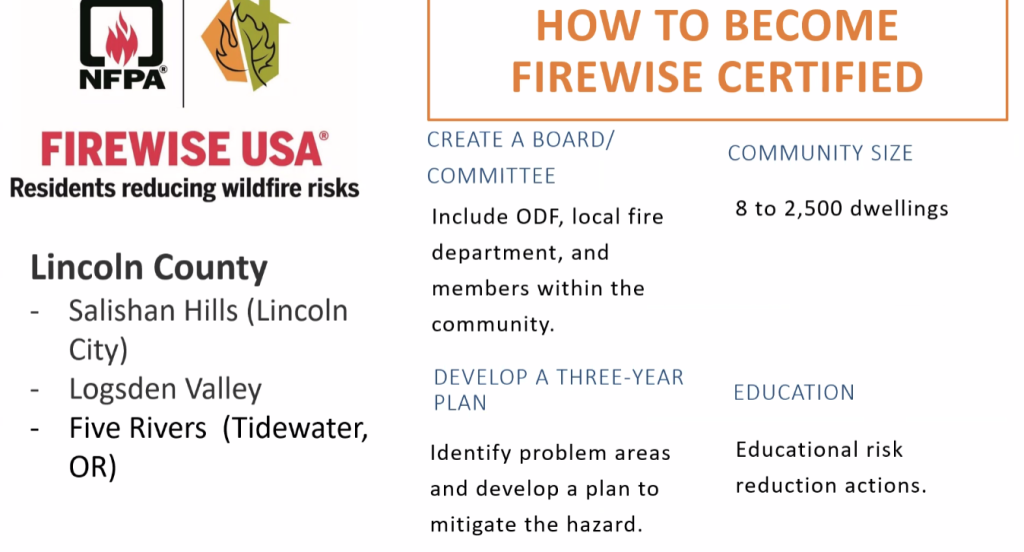
Oregon Wildfire Readiness Guide


Help build our COAD!

Residents interested in becoming involved with Lincoln County COAD efforts, preparedness planning, volunteer coordination, or future training opportunities are encouraged to reach out to:

Allyson West
Lincoln County LTRG / COAD
director@lincolncoad.org

Community members do not need to wait until a disaster occurs to become involved. One of the major goals of the Lincoln County COAD effort is building relationships, volunteer networks, communication systems, and preparedness capacity before emergencies happen.