Great Oregon ShakeOut: Let’s Be More Ready Than Less
October 15, 2026 — Today’s Great Oregon ShakeOut is a chance to turn concern about earthquakes into something useful: practice. The coordinated drill is at 10:15 a.m. local time. If you miss that moment, choose another time to rehearse with your household or coworkers. Oregon’s official ShakeOut information explains how to participate.
Let’s be more ready than less. Practice helps make us safer. It helps us respond instead of react.
Practice Drop, Cover, and Hold On
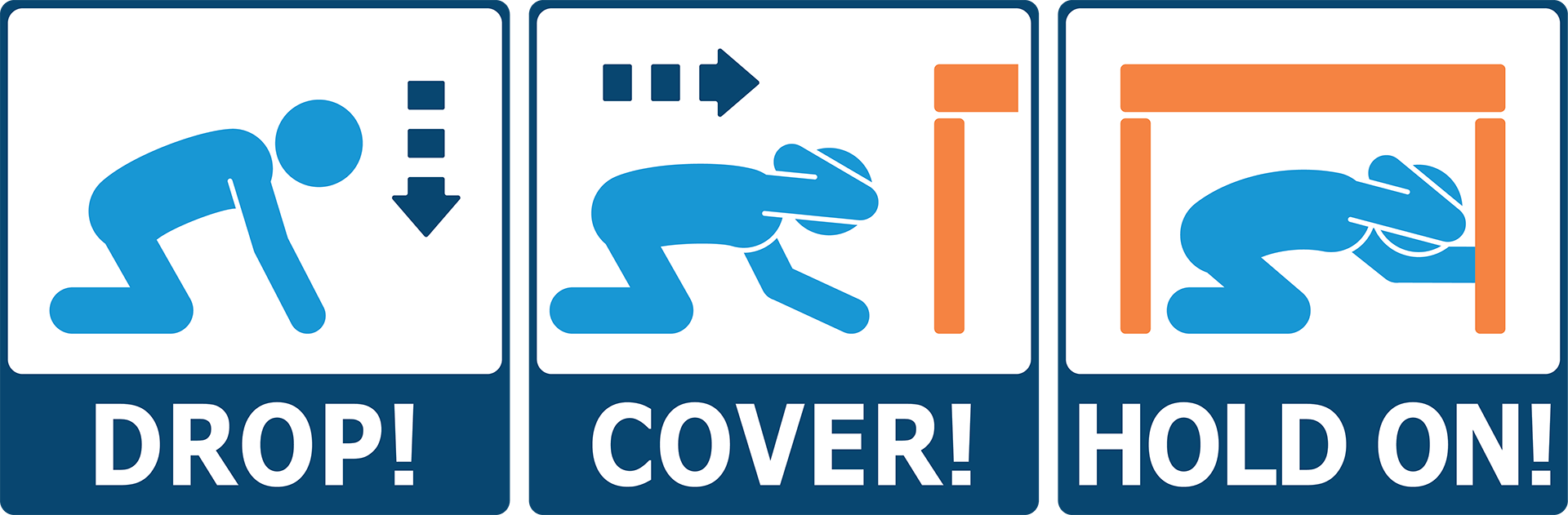
- Drop onto your hands and knees where you are.
- Cover your head and neck. Get beneath a nearby sturdy desk or table if possible; otherwise protect yourself away from windows.
- Hold On to your shelter and be ready to move with it until shaking stops.
Adapt the drill to your abilities. If you use a wheelchair, lock the wheels if possible, cover your head and neck, and hold on. Do not attempt to get onto the floor if you cannot safely do so. Accessible safety guidance offers more options. Practice the actions you would use where you live, work or study.
We live in earthquake country
Off our coast, the Cascadia Subduction Zone can produce a magnitude 9 or greater earthquake and a destructive tsunami. Inland communities also face earthquake hazards. Preparedness is part of living here. Oregon Emergency Management’s earthquake guidance explains the risk and protective actions.
Near the ocean, protect yourself during shaking. After a large earthquake, once shaking stops, walk inland and to high ground without waiting for an official warning. Know your local evacuation route before you need it. The first action during shaking and the next action afterward are both worth practicing
During my years as Lincoln County’s public information officer, I saw how Japan’s March 2011 earthquake and tsunami and the dock that later washed ashore at Agate Beach made preparedness feel immediate. In my experience, those events prompted more conversations about our own risks, evacuation routes and whether our families were ready.
The dock came from Misawa, Japan. Torn loose in the 2011 disaster, it drifted across the Pacific before reaching the Newport area in June 2012. Its arrival was separate from the tsunami waves themselves. A preserved section became an educational exhibit and memorial at Hatfield Marine Science Center. OSU’s account tells that story.
There is a personal connection for me, too. Commissioner Terry Thompson was one of the commissioners I worked for. In 2013, he traveled to Misawa with OSU scientist John Chapman and Natural History Museum researcher Leslie Harris as they investigated organisms on replacement docks. The museum’s May 2013 research newsletter, page 7, documents their visit.
What stays with me here is the connection between public service, science and people helping coastal communities understand a shared risk.
Kathryn Schulz’s widely discussed 2015 New Yorker article, “The Really Big One,” brought further attention to Cascadia. Awareness can start the conversation. Practice gives us an action to take.
Well done Lincoln County
After the drill, talk about what you noticed. Is your cover spot accessible? Could something heavy fall nearby? Does everyone know where to meet and how to reconnect? Coastal households should review their evacuation routes together.
Use the Seven Steps to Earthquake Safety to build on the drill, from securing your space and planning communications to supplies and recovery. Oregon’s Be 2 Weeks Ready program provides household planning resources.
We don’t have to solve every preparedness problem in one day. We can practice, find a gap and do something about it.
Let’s be more ready than less.