Last updated: 5.26.26
Commissioner Casey Miller currently serves in a co-chair governance structure on the Lincoln County Board of Commissioners.
Under Oregon law (ORS 203.240), senior commissioners may hold authority associated with the Chair position based on tenure. In 2026, Miller proposed a collaborative co-chair framework intended to support continuity, shared governance, and organizational stability during a period of transition following the passing of Commissioner Claire Hall.
Miller has consistently advocated for greater clarity regarding:
• delegated authority and operational procedures,
• review and implementation of Ordinance 517 (Establishing the Position of County Administrator).
• governance and reporting structure,
• and transparency in organizational decision-making.
These discussions have been raised publicly during Board meetings as well as internally through direct communication with county leadership and staff.
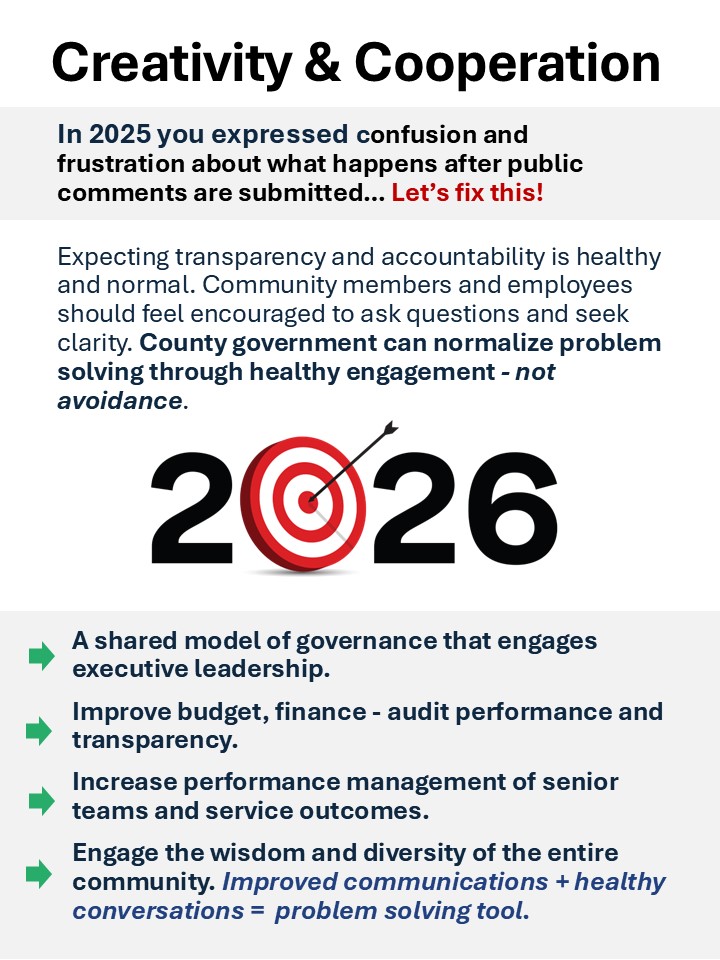
Lincoln County has operated for an extended period (most of 2025) without a contracted County Administrator. During that time, questions regarding delegated authority, reporting relationships, supervisory structure, and operational oversight have increasingly become central governance concerns.
Miller has repeatedly emphasized that effective local government depends on:
• clear organizational structure,
• documented processes,
• transparent communication,
• and accountable decision-making.
These concerns align with guidance and training repeatedly emphasized by CIS (Citycounty Insurance Services), which stresses that ambiguity, inconsistent communication, lack of documentation, and failure to clarify expectations can increase organizational risk and perceived unfairness.
Miller believes the County would benefit from:
• clearer governance protocols,
• improved process mapping,
• stronger public transparency,
• and more proactive organizational communication during periods of administrative transition.
Public meetings are where governance legally happens
Public meetings are the formal mechanism through which a Board of Commissioners carries out its governing authority. In Oregon, elected commissioners do not govern through private conversations, individual actions, or informal agreements — they govern through public meetings.
Under Oregon Public Meetings Law (ORS 192.610–192.705), decisions of a governing body must be made openly and transparently.
This means:
- Policy direction
- Budget decisions
- Resource allocations
- Intergovernmental agreements
- Major organizational priorities
Oregon recognizes that communities are best served when governance takes place in a public setting where all can observe the process. The public meeting is not just a formality — it is the legal forum where authority is exercised – the core democratic mechanism through which the Board of Commissioners exercises authority, sets direction, and remains accountable to the people it serves.
Agenda composition should be an equitable representation of the entire Commission’s governance priorities in cooperation with elected officials, executive leadership, and administrative staff to deliver services to the community.
When agendas are built collaboratively and decisions are made publicly, the community can trust that county government is operating openly, lawfully, and in alignment with its shared governance responsibilities. It is critical that the Board meets and passes motions to establish clarity, direction and shared consensus in the public meeting.
Historical: Miller’s agenda requests repeatedly withheld from public view.
Commissioner Meeting Agenda Packets: 2023-2026
I’ve been consolidating all BOC meeting packets for each year and producing summaries. The BOC approves 300+ documents a year in the public meeting. Combining ALL meeting packets for 2023 is a MASSIVE document and simply difficult to manage form a data perspective. Combining all meeting packets for 2023 is over 5,000 pages. Moving foreword I would to produce systematic summaries each month to avoid this massive data convergence challenge.
2023 – Packet Analysis and Summary
I am working on a data management process. To review the packets please visit the county’s website.
2024 – Packet Analysis and Summary
In process. To review the packets please visit the county’s website.
2025 – Packet Analysis and Summary
In process. To review the packets please visit the county’s website.
The Board is collectively responsible for the governance, operation, and oversight of county government. Lincoln County government is composed of more than 500 employees, represented through county leadership and management, including elected officials, department directors, and dedicated staff who deliver essential public services to the community.
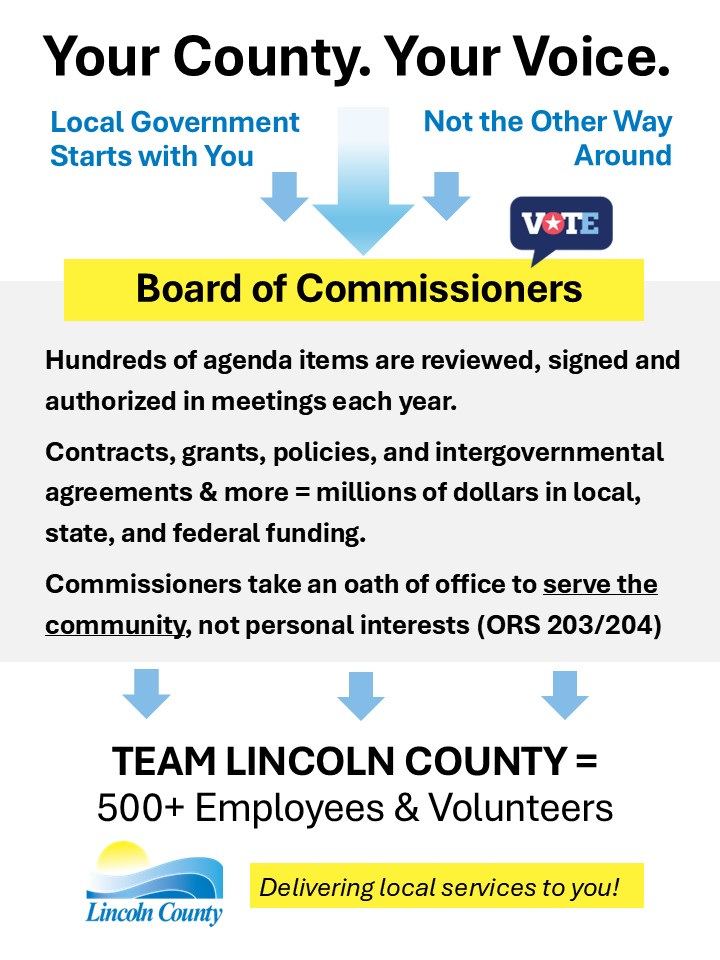
Imagine the potential of Lincoln County when every executive leader is upstreaming insight to the Board — so we can see challenges early, align resources responsibly, and serve our communities with clarity and resilience. The strongest counties are not reactive — they are aligned. When information flows upstream to the Board and back out to the community, we move from fragmentation to shared purpose.
Transparency builds public trust
Public meetings ensure that:
- Community members can see how decisions are made
- All perspectives are heard on the record
- Commissioners deliberate openly
- Outcomes are documented and accessible
This transparency protects both the public and the governing body by ensuring decisions are not made privately or without accountability.
The agenda shapes what governance occurs
The meeting agenda is the roadmap for what the Board can legally deliberate on and decide. If an issue is not on the agenda, it generally cannot be fully discussed or acted upon.
For that reason, agenda composition should reflect:
- The priorities of the full Commission (not just one member)
- Organizational needs and service delivery requirements
- Input from elected officials, executive leadership, and staff
- Emerging issues affecting the community
An equitable agenda ensures that governance reflects the collective responsibilities of the Board and the needs of the community it serves.
Public meetings connect governance to service delivery
The purpose of governance is not simply discussion — it is to ensure that county government remains:
- Functional
- Transparent
- Resilient
- Able to deliver services to the community
Public meetings are where the Board aligns community needs, workforce capacity, and available resources into clear direction for the organization.
Commissioner Hall served as Chair most of 2025. Counsel Yuille has been lead counsel since 2021. She has stated to me that “your items of business might not be the county’s business”. Counsel Belmont became assistant counsel in 2021.
Several weeks ago, I discovered that changes were made to the county’s website that had redirected my commissioner email to staff instead of me directly. Please reach out to me directly until a clear policy and procedure is agreed upon by the Commission about how communications such as emails are handled on the County’s website (and elsewhere) that are intended for the Board.