Last updated: 7.3.26
Below are three budget versions that were provided the Board of Commissioners. While the Budget Committee approved the second version on 6.4.26 , the Board approved the third version on 6.17.26.
26-27 Adopted Budget – 6.16.26 (Version 3) (optimized for mobile devices)
26-27 Proposed Budget – 6.1.26 (Version 2) (optimized for mobile devices)
26-27 Proposed Budget – 5.19.26 (Version 1) (optimized for mobile devices)
– Fiscal Year 2025-26 Budget Book (Stories OPENGOV)
– Fiscal Year End Audit 25 (Unavailable) – Finance and departmental staff are currently assisting the auditors to complete the audit for the 2024-2025 fiscal year.
The FY26–27 Proposed Budget Message outlines a county government attempting to balance rising operational costs, service demands, staffing pressures, and financial uncertainty while maintaining core public services. Lincoln County is attempting to maintain (and in some areas expand) public services during a period of significant uncertainty involving inflation, healthcare costs, staffing pressures, administrative instability, and unpredictable federal/state funding.
REVIEW THE 26-27 PROPOSED BUDGET – PROVIDE FEEDBACK
More details on the upcoming meetings in the CIVIC CLERK Agenda Portal
Budget Committee
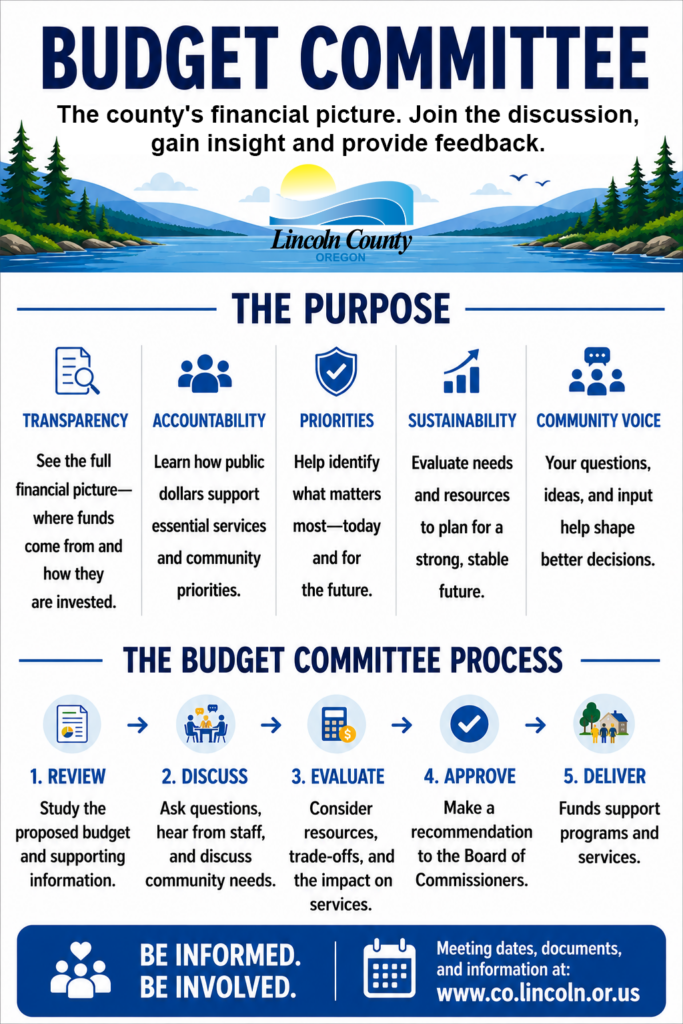
The purpose of the budget and the Budget Committee is much larger than simply approving numbers. Budgets reveal organizational priorities more honestly than rhetoric. A budget is not merely a financial document — it is a public expression of values, priorities, leadership, and policy direction.
The County’s annual budget process is guided by the State of Oregon’s Local Budget Law. The budgeting process has four parts. The budget is: 1) proposed by the Budget Officer, 2) approved by the Budget Committee, 3) adopted by the Board of Commissioners, and 4) executed by the County Administrator, along with the Board of Commissioners and County Departments. As part of adopting the budget, the governing body makes the necessary appropriations and certifies to the county assessor the tax to be imposed.
Oregon Local Budget Law requires the following:
– An annual budget be adopted prior to the beginning of the fiscal year, July 1, to which it applies
– There must be notification of public meetings when the budget is discussed
– A summary of the budget must be published in a local newspaper prior to adoption
– There are opportunities for public input
– After the Board of County Commissioner’s adopts the budget, amendments are made through the budget adjustment process
The Budget Committee reviews the proposed budget in open public meetings, receives input from the public, approves a final budget document for possible adoption by the Board of Commissioners, and sets the ad valorem property tax rate to be levied. Citizen Budget Committee Members who join the County Commissioners to form the Budget Committee are:
Christen Don 12/31/2026
Tom Fullmer 12/31/2027
Vacant 12/31/2028
“Will the 26-27 proposed budget accurately reflect the county’s priorities, risks, and stewardship of taxpayer dollars?”
The committee exists to publicly determine whether county resources, staffing, and priorities are aligned with the community’s values, operational realities, legal obligations, and long-term financial sustainability. The budget process should create opportunities for elected officials, budget committee members, and the public to challenge assumptions, ask questions, understand definitions and mechanics, and where possible improve upon historical practices. Through transparency, strategic planning, and public participation, the budget process helps ensure that community priorities, fiscal responsibility, and quality public services remain connected and sustainable over time.
In the absence of a countywide strategic plan, the Budget Committee can still meaningfully rely upon Lincoln County’s mission statement as a foundational guide for fiscal and operational decision-making. The mission of Lincoln County is “to provide legally required and locally desired essential public services in an efficient, effective, and respectful manner.” Until the County establishes more uniform long-term strategies, measurable goals, and coordinated organizational priorities, the departmental budget narratives themselves help communicate the evolving aspirations, responsibilities, and service objectives of county government.
At its core, the county’s foundational service profile — public safety, health and human services, infrastructure, planning, administration, and community support systems — is inherently tied to the economic stability, resilience, and overall well-being of the community. Sustainable budgeting therefore is not solely about balancing expenditures and revenues, but about responsibly maintaining the organizational capacity necessary to support essential services, community confidence, and long-term public value for the residents of Lincoln County.
“As we move into the FY 2026–27 budget process, I want to continue encouraging a transparent and deliberative public discussion regarding the county’s financial priorities, organizational structure, and stewardship of taxpayer dollars.”
Under Oregon budget law, the Budget Committee plays an important oversight role prior to formal budget adoption. ORS 294.428 specifically provides that the Budget Committee may: “demand and receive from any officer, employee or department… any information the committee requires for the revision and preparation of the budget document.
The process is intended to allow committee members and the public to: and examine organizational and financial issues before adoption. ask questions, request clarification, understand assumptions, and examine organizational and financial issues before adoption.
Understanding the Roles of the Budget Officer and Finance Director
As Lincoln County continues navigating complex financial, operational, and organizational challenges, it is important for the community to understand the distinct — yet closely connected — roles of the Budget Officer and the Finance Director. Developing the proposed budget is a cooperative effort among all County departments, the Board of Commissioners, and the County’s management team. In Lincoln County, Lennon Pierce currently serves in both capacities, carrying significant responsibility on behalf of the organization and the public.
The Role of the Budget Officer
Under Oregon Local Budget Law ORS 294.331, the Budget Officer is responsible for coordinating and preparing the county’s proposed budget for review by the Budget Committee and Board of Commissioners. This role helps guide the public budgeting process by: coordinating departmental budget submissions, preparing the budget document and budget message, supporting transparency and public participation, and helping ensure the budget is balanced and legally compliant.
The budget officer shall act under the direction of the executive officer of the municipal corporation, or where no executive officer exists, under the direction of the governing body. This effort includes developing a budget calendar, projecting available revenue for the new fiscal year, requesting information from County departments including proposed departmental budgets, compiling all information and presenting a proposed budget proposal to the Budget Committee for their review
In many ways, the Budget Officer serves as a steward of the public budgeting process itself — helping elected officials, budget committee members, and the community understand the county’s financial picture, operational priorities, and fiscal policies.
The Role of the Finance Director
The Finance Director’s responsibilities extend far beyond the annual budget process. The position is responsible for the county’s broader financial management systems, including: accounting and financial reporting, audits and internal controls, cash management and forecasting, payroll and financial compliance, debt management, and maintaining the long-term financial stability of the organization.
While the Budget Officer helps facilitate the annual public process of developing the budget, the Finance Director helps manage the county’s day-to-day financial operations year-round.
Why Both Roles Matter
Although these roles are different, they work together closely. The Finance Director provides the technical financial foundation and operational analysis necessary to prepare a credible budget, while the Budget Officer helps translate that information into a transparent public process designed to support informed decision-making and community trust.
Together, these responsibilities help bridge: technical finance and public policy, operational management and public transparency, short-term budgeting and long-term sustainability.
In that context, recognizing Lennon Pierce’s service in both roles is also a recognition of the complexity and weight of helping guide Lincoln County’s financial operations and public budget process during a particularly demanding period for county government.
State Law – Budget Process
Local Budgeting in Oregon – Manual
Schools, education service districts, community colleges, counties, cities, urban renewal agencies, and most special districts are all subject to the same budget provisions, Budgeting allows a local government to evaluate its needs in light of the revenue sources available to meet those needs. A complete budget justifies the imposition of property taxes and the making of the appropriations that give the government its authority to spend public money.
Local Budgeting in Oregon – Resource Guide
Besides outlining programs for the coming year, the budget controls the local government’s spending authority. Since the budgeting process encourages citizen input, the budget is also a vehicle for obtaining public opinion about proposed programs and fiscal policies of your jurisdiction.
Local Government Audit Report Search – (Lincoln County’s Audits for Fiscal Year End – 20, 21, 22, 23, 24 available on State Website)
Oregon Audits Division. Many local governments contract with accounting firms to audit their financial statements. To ensure these audits are properly conducted, the division administers Municipal Audit Law and its requirements. We also evaluate the audit reports and reviews of these local governments and the auditors’ workpapers for compliance with prescribed standards. The division exists to fulfill the Secretary of State’s constitutional and statutory audit authority. We do this by auditing to protect the public interest and improve Oregon government.
Resources for New Government Officials
You are a public official (ORS 244.020(15) Effective governing bodies instill trust in their constituents through well-organized, honest, respectful, and transparent operations. As a new member of a governing body, there are many resources available to help achieve these goals.
VIDEO – Municipal Budgeting Basics with Kerri Nakamura
VIDEO – County Budgeting with Kerri Nakamura
VIDEO – Municipal Budgeting Overview
VIDEO – Rethinking the Budget Process
VIDEO – Strengthening Internal Controls to Prevent Fraud for Local Governments
VIDEO – Government Accounting Standards Board (GASB)
FY 2026-27 BUDGET PREPARATION CALENDAR
LINCOLN COUNTY, LINCOLN COUNTY EXTENSION SERVICE DISTRICT, LINCOLN COUNTY SOLID WASTE SERVICE DISTRICT, LINCOLN COUNTY
TRANSPORTATION SERVICE DISTRICT, LINCOLN COUNTY ANIMAL SERVICES DISTRICT, & SILETZ LAW ENFORCEMENT DISTRICT
January 2026 Department
1) 29th M-Team Discussion of Budget Calendar Preferences Finance
February 2026
2) 13th Revenue Forecast Complete – Finance and Treasury,
General Fund tentative revenues, key expenditures, etc.
3) 13th FY27 OpenGov Budget Instructions Issued for All Departments Narratives and Projections & Open Gov open for narrative input/completion
4) 27th FY27 Online Budget Book Narrative Updates Submitted All Departments
March 2026
5) 6th Budget Committee Membership Confirmed Administration
6) 13th FY26 Current Year Projections Due in OpenGov All Departments
7) 13th FY27 OpenGov Budget Instructions Issued for FY 2026-27 Proposed Budget & OpenGov opens for All Departments Proposed budget input/completion
8) 20th Positions frozen for budget purposes All Departments
9) 31st FY27 Department Request Budgets for FY 27-28
Proposed Budgets Due All Departments
10) TBD Compensation Committee meets & prepares recommendations
April 2026
11) 3rd FY27-28 Support Service Fee Estimate Distributed Finance
May 2026
12) 7th Notice of Budget Committee Meetings published and posted on
website
13) 8th Proposed Budget distributed to Budget Committee
14) 26th, 28th, 29th Budget Committee Meeting, 6:00 pm, Electronic/BOC Chambers*
15) 27th Siletz Budget Committee Meeting, 6:00 pm, Electronic/Siletz City Hall*
June 2026
16) 4th Budget Committee Meeting, 6:00 pm, Electronic/BOC Chambers*
17) 11th Form OR-LB-1 Notices of Budget Hearings published Finance
18) 17th Public Hearing and Adoption of FY2025-26 Budget for the County & all Special Districts governed by the County Board of Commissioners: BOC regular meeting, 10:00 am Electronic/BOC Chambers
July 2026
19) 10th * Form OR-LB-50 filed with Assessor Finance